
HAP DAVIE HAS NEW MUSIC OUT.
HE DOESN’T CARE IF YOU LISTEN TO IT. WE DO.
Hap Davie creates music when it comes to him. His songs are refreshing, but nostalgic. When he shared his new music with us, we immediately knew we had to feature him.
Read our interview with David below.
photos by David Watz @hapdavie
HD: Tunes open up?
FH: We listened to them and then I listened to them again today. They're really good. I really like “Fitter Seasonings.” I think it’s my favorite.
HD: Cool.
FH: How did you develop your voice? The singing voice is a bit different from what I've heard in folk songs.
HD: That’s the thing that people struggle with. They talk about the vocals, but the reality is, I'm quite proud of the vocal delivery in these songs because it was developed over the years. It’s a studied and very intentional thing.
I'm very critical of other so-called folk singers. Not to get combative but, I'm quite critical of that sometimes because I can hear when it's phony.
Maybe people will listen to me and think it's phony, but that was really developed over years. I can hear it when I listen to my stuff that goes back further than what's on the new record. It came from not just the music, but from literature and reading. It’s born out of regional accents and idiosyncrasies in language. It's very American and very intentional in the way that I'll use inflections and certain phrases.
FH: Can you give any specific examples?
HD: Sure. I was very influenced by Mississippi John Hurt. There's a whole soft blues thing that I was very influenced by which is like him or Elizabeth Cotten or Furry Lewis or Skip James. Those are a few distinctive voices and I knew early on that it was something I was after, but I didn't want to be after it just for the sake of it. Some of the ways that I say things are what I heard my grandparents say certain words.
FH: Everything that you do seems to be very intentional–from the lyrics to the vocal delivery. I want to touch on the writing process. How do you choose what poems or ideas to bring to fruition?
HD: I'm never writing–hardly. They come in bursts and lately it happens every several years–I swear. The solo record that's been out, half those songs are essentially covers. There's really only one original song on that record, which is “Wedding Ring”. I don't even remember when I wrote that. Years and years ago. The song “Fitter Seasonings” and “Honeydew”, I wrote that in a burst. I probably wrote fifteen other songs with it. I'm very creative, but I'm very slow with it. I hardly write ever, but when I do, it happens.
FH: Everybody is a little different with their creative process. Is there any part of you that wishes that you were more disciplined?
HD: I used to wish that, but I have no career ambition to be a musician. I'm a carpenter. That's what I am.
I kind of stopped wishing that. When it happens, it is so much fresher for me.
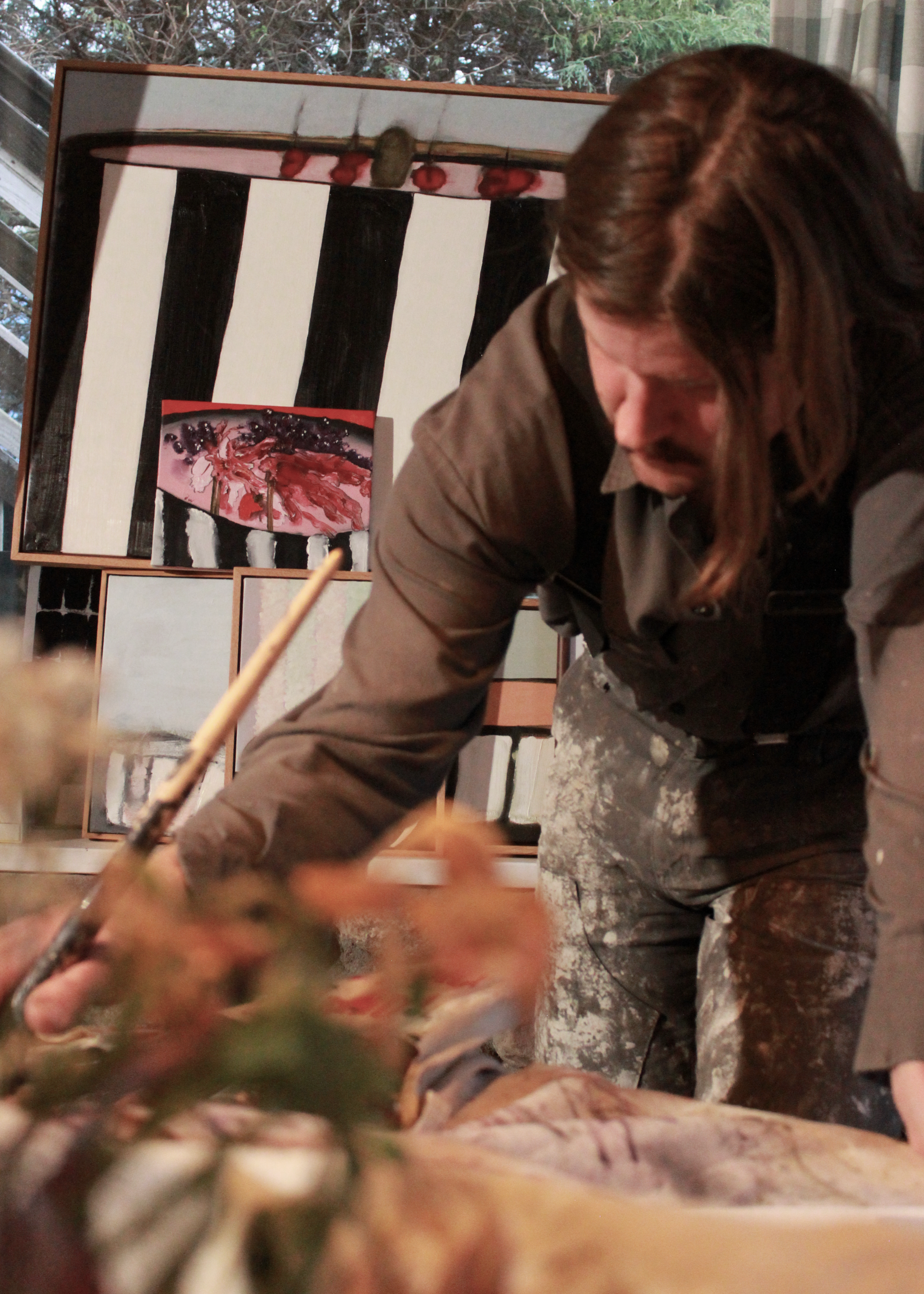
I mean, Rian-you know I'm a painter, too. Last time we spoke I was painting a lot. I haven't painted in months, and it's because I could feel my style kind of stagnating. Whenever that happens, I just have to breathe on it for a second. Now it's been around four months and I haven't painted a thing. I know when it happens, it's going to be an outpouring. That's just what it is for me. And yeah, I stopped wishing.
FH: I think, sometimes, being disciplined doesn't get you to a new place faster.
HD: Sometimes when I get down on myself, you know, we all get down on ourselves sometimes, and I'll be like–I need to be more disciplined, I need to create just to create. I like that, it's not a bad way to be. It’s healthy even, but I'm just so–don't get me wrong–to a fault, I'm so precious with the integrity. I guess I'll say of my creative process, it doesn't feel as good to me when I'm just doing it to produce because that's discipline. Then again, this is not my career, so it doesn’t need to make me money. You know, I don't have to do it, so maybe if I had to, if it paid my bills, I would have a different answer.
FH: Do you want to talk about “Fitter Seasonings” specifically? That one definitely paints a picture of a moment in time.
HD: I would call “Fitter Seasonings” and “Honeydew” memory songs. I was definitely thinking about my childhood. I mentioned Fort Wayne in “Fitter Seasonings”. That's sort of where I'm from. My great-grandfather had a little nickname. That’s where I adopted Hap. He was a carpenter and he built this little lake house. That's what I was thinking about for both of those tunes. I was thinking about our family, who is totally broken up now since my grandparents passed. We don't really see each other or speak the same way. Not my immediate family, but my extended family. Back in those days, when I was a kid, we'd all get together. That's really what “Fitter Seasonings” is about. Really simple things like that. Those are memory songs, more so than the songs that are on Disneyland. I was working on some completely different record for months and months. I was just picking it apart obsessing over. They weren’t folk songs, and I got tired of it. Trashed the whole thing and made Disneyland in a couple days. It was because that's what I was listening to. I was like–why am I making this music when I'm listening to these field recordings and, like, dirt folk tunes that nobody's ever heard of?
FH: Let’s talk about the other track, “Honeydew”.
HD: “Honeydew” is a lot more vague and kind of draws on experiences that are not my own, but even in writing I feel like they are just as valid, sometimes. Just to imagine things. I mentioned Memphis, I've never been to Memphis, actually. I was recording in a closet. I had my tape recorder, I had my cat–I had a cat at the time–and a big book of Grandma Moses paintings, probably my favorite folk painter. They're just so simple and self-evident. That's not to say those two songs are especially self-evident, but I wanted to make them so you can feel them and understand them for what they are, without even having anything to do with what I'm saying, personally.
They're just supposed to be adorable. If that's all you take from them, then it's a success. They're only supposed to be adorable, you know?
FH: I like that. Not all the things you write about may be your own memories, but perhaps it still gets you there. It's where you wanted it to go.
HD: In the chorus of “Honeydew” I use the word memory. It's a memory song. It’s about feeling tired–feeling burnt out. Thinking about a time that maybe it didn't feel that way. Even though it wasn't. We romanticize the past as if we weren't as stressed. We probably were.
FH: What's your relationship with memories and false memories? Knowing it's not reality, but it can be useful–especially as an artist.
HD: I lean right into it. I'm such a romantic when it comes to the past. I think it's healthy. It gives my life luster. Past memories give my life substance and meaning. Probably everybody is that way, but I'm very much that way. When I was a little kid, I obsessively watched home videos from every Christmas. My mom was very concerned. I watched our Christmas tapes over and over and over–for the nostalgia and the feeling of it. I was probably like nine. Why am I pining over the past? I'm nine years old.
FH: The good old days, right?
HD: That's what I mean, you think about the past as if you were less stressed back then. Probably you weren't, but it's okay. It's so okay to romanticize things. Romanticize the past and just watch it like a movie. You know, memory.
You can just watch your memories like a movie. I'm very much like that.
FH: I relate to that a lot. I think a lot of people romanticize the past.
HD: I made those songs in 2019, and to be honest with you, I had forgotten about these songs. The only reason I'm releasing them now is because you're asking me to talk about them. I was like–oh, I have these other songs I should put out if I'm going to talk about my music. I made those songs, you know, seven years ago, but I think letting all that time pass… I think time, especially with these songs, is a huge factor in my creative process. I often wonder- why do I listen to field recordings that sound like shit and why do I romanticize music that's older than music that is current? I think a lot of people do that too, and the only way I can reason it out is to be like, there's a time element here. We're just back to romanticizing memories, being nostalgic about things. I guess you can call it luster or whatever you want. Time gives things that quality, whatever it is that we're talking about here, and in recognizing that, I almost try to give the things I create–I try to imbue it with that sense. Seven years have passed since I recorded these songs, and I forget making them. I forget how it felt to write them. I'm so separate now from that record that I can even romanticize them in a way. If I didn't have that perspective on them myself, I would feel differently even about giving them to other people to hear. You know, my favorite paintings are ones that I look back at after some time has passed and they just, like, got old. Some things just die, don't get me wrong. Some things, you put time up against it and they just die completely, but other things take on that–I keep saying this–take on that luster.
FH: They become far away from you, so there's room for you to rewrite the script.
HD: It’s been seven years since I recorded that song. Now is the time for me to release it and have other people enjoy it, if they want. Even though that seven years doesn't exist to them.
FH: If you're excited about it then I think that's the most important thing. That's the whole point of doing it. Even if no one else is excited, which is often the case, but at least you did it… I don't think we talked about you living in a van yet.
HD: I mean, that's roaming free in a literal sense. I've sort of roamed in my entire adult life. I bought a van and I was traveling around a little bit. I was spending a lot of time camping in just big fields in the Dakotas. Not picturesque vacation spots, but just, like, big open nothings. That's exactly what I was after. I was after the highest sense of freedom that I'd had ever felt. That was very intentional. I've never felt freedom like that before, or since. I spent days and days not seeing or talking to anyone. That was huge for me. You know, if I'm talking about freedom... freedom has been like the supreme north star for me in my life. Maybe to a fault. It made my life easier.
We don't live in a free world. We just don't. We’re born with it. That’s the ultimate irony.
I've just spent my life chasing that because I need it. It stresses me out if I don't have a certain amount of freedom. At that time in my life, I was completely unencumbered by things. It was the perfect moment for me. Vanishing–it's almost a defense mechanism for me. I have to vanish every once in a while. I have to. I just have to. You know the saying “I love you, but I'm leaving”? It’s not that that's a healthy way to be, but it's freedom. It's freedom for me.
FH: I think you have to sometimes. A lot of people need to isolate and disappear to get to know themselves. You can adapt too much when you're around other people. No matter who it is.
HD: I will say that I'm quite well acquainted with myself. You can't get that when you are so fixed to the world that you operate in. Whether that's friends or school or your job. There's a lot of comfort in those things, but those things often decide who you are. I've never liked that feeling. I guess–yeah, it takes your energy. I like where I'm at right now, and I have no plan to leave, but I don't know. I do know that I wouldn't feel the way I feel about my life now and who I am as a person if I hadn't been nobody in the middle of nowhere. With nothing to do–nothing. Nowhere to be. No one to talk to. I wouldn't write the same songs. I wouldn't have found folk music in the same way. I wouldn't have developed my vocal style–on a superficial level. For me, folk music is just such a personal medium for creativity. I was always fascinated by true folk musicians. Nobody had songs… no career ambition. What is a career–you know? There’s freedom in that, honestly.
There's almost freedom in knowing that no one in the world listens to your music. That's such a funny thing to say.